


The late Michael Silverblatt once said that Alice McDermott “somehow constructs whole worlds in a tiny space.” As I worked on my novel, I reached for others covering similar terrain. There could not be a more obvious analogue than Alice McDermott’s The Ninth Hour (2017; Finalist for the National Book Critics Circle Award and the Kirkus Prize), which uses a similar structural conceit within a family story, the Catholic canonical hours, to tell a larger story.
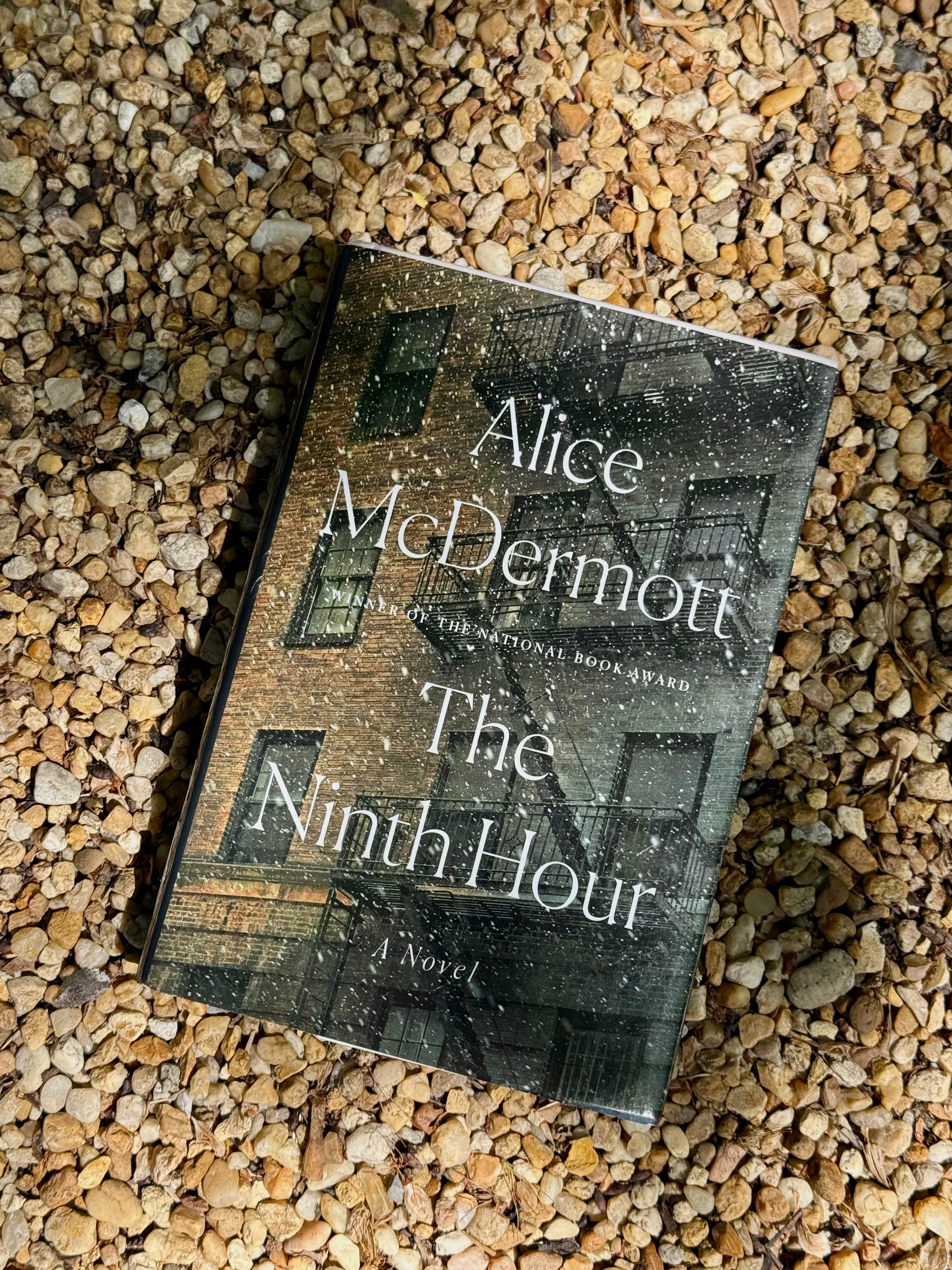
The “Ninth Hour” in the Catholic canonical hours is ‘None’ (pronounced noh-neh) prayed at 3 PM and historically associated with the death of Christ.
Let me take a step back here to say that obviously Alice McDermott is a living legend and among the giants of precisely rendered fiction. Across her work, the reader finds that she often holds a moral life in suspension rather than resolving it. You see it in Charming Billy (1998), After This (2006), and Absolution (2023).
The move most writers don’t make
Withholding judgment is a familiar craft virtue, the workshop cliché of don’t judge your characters. But that is usually a rule about the narrator’s stance. What McDermott does is different and more difficult. She has this uncanny knack for navigating her characters’ own ongoing negotiation with the past—the act of turning the same events over, finding new meanings, suspending verdicts they thought they had reached. Yet the judgment that gets withheld is not McDermott’s about her characters. It is the characters’ about themselves and each other.
That is a rarer move, and it is closer [at least as I’ve tried and often failed to reflect in my own life] to how consciousness actually works. A lot of fiction gives characters interior monologues that build and build and build until they reach a conclusion. The character thinks something through, inveighs to themselves, then arrives somewhere. The ol’ well-trodden path of the epiphany structure, even in novels that claim to resist it. In The Ninth Hour, McDermott’s characters think their way toward understandings and then keep thinking, and the understanding gets revised, softened, complicated, sometimes abandoned. Sally’s feelings about her mother’s marriage. Annie’s about Jim. The nuns about each other. She manages to keep readers in this liminal space because we recognize it in our own lives—even if we aren’t always honest to ourselves. In The Ninth Hour nothing settles, because in real life nothing does.
The craft mechanisms are worth naming. In The Ninth Hour, McDermott does it in three specific ways:
Time as solvent [which sounds fancy and academic but is really just how memory works]. The collective narrator, looking back across decades, makes every judgment provisional. The reader knows more time will pass, more context will arrive, and what feels like a conclusion now will look different from the other side of another death, another child, another decade.
Sympathy that outlasts context. McDermott gives the reader reasons to judge. The novel opens with Jim’s suicide preparations. Then there’s Annie’s hidden longing for intimacy, written in scenes that make the reader flinch with her. Mrs. Costello’s manipulations. Sister Jeanne’s final act. Sally on the train to Chicago, intent on her vocation, gulled and disgusted and then cruel herself when the girl in the next seat plays her for money. McDermott keeps rendering these characters with a tenderness the information does not license.
Revised memory. Characters return to the same events and remember them differently. Not unreliably in any gotcha sense, but in the way that memory works, where what you notice in a scene changes based on what has happened since. [I keep trying to do this in my own work and find it’s difficult to stick the landing without being heavy handed.]
To achieve this, she makes a structural choice that carries the novel forward from the central wound of the family rather than backward toward it. Most literary novels about family trauma are archaeological. They move backward through time. Something happened before the book began, a death, a betrayal, a buried secret, and the narrative is the slow approach to it. The reader arrives at the wound alongside the protagonist, and the arrival is the climax. We have so many novels in this shape that we have stopped noticing it is a shape.
The structural refusal
The Ninth Hour opens with the character of Jim closing the windows, sealing the door with rags, turning on the gas. His pregnant wife Annie is out. She comes home to the smell. A neighbor runs for help and a nun arrives. By the end of the first chapter we know what happened and why, and the rest of the novel, three generations and several decades and a dozen lives, unfolds forward from this scene rather than back toward it. This is obviously a big structural choice and it changes everything the novel can do.
Archaeological novels have to land a verdict. Of course, that is what the approach to the buried thing is for. By the time the protagonist reaches the wound, the novel has arranged its material so that the meaning(s) becomes clear. The father was cruel, the mother was complicit, the child survived, and now we understand. Understanding is the reward for the excavation.
The Ninth Hour cannot deliver this, because you cannot reach a verdict on a story that keeps going. Annie remarries. Sally is born, grows up, considers the convent, turns away. The Little Nursing Sisters of the Sick Poor tend the dying. Sister Jeanne, near the end, does a thing you could call sin or you could call mercy. And McDermott does not tell you which, because the grandchildren who narrate the book are still alive and still thinking about it. Yeah. I know. She’s doing something wild and magical here. Every judgment the novel seems to reach is revised by the next chapter, the next generation, the next death. Time keeps passing, meaning keeps moving. It is the moral texture the forward structure makes possible.
If you’re reaching for this book for the first time, watch closely how she handles Jim. The opening chapter gives you every reason to judge him. A young husband, a pregnant wife, a selfish and devastating act. The novel could have positioned him as the wound the family approaches and understands. Instead McDermott keeps rendering Jim, across years and perspectives, with a tenderness the information does not license. Annie’s memory of him softens and hardens and softens again. Sally, who never met her father, inherits a version of him that is not quite her mother’s. The nuns, who cleaned the apartment, carry their own. No single Jim emerges. The reader is not permitted the comfort of a settled view. The grandchildren serve as the collective narrator for The Ninth Hour, acting as an instrument of the unsettled point of view. The voice McDermott uses is both far enough from the events to see around them and close enough to the family to keep caring. And this voice refuses to stop revising into the future.
The Ninth Hour has stayed with me long after I finished it—the echo of that voice and arc of each character lodged into my skin like the best kind of splinter.
My notes in the margin and notebook were copious and thorough. McDermott shows how a moral life actually works—not through a series of verdicts that are reached and filed away—but as an ongoing negotiation with people who are no longer here and a past that cannot be changed. The understanding I reached at forty-two looks different than twenty-two, not because I have learned the absolute truth about the world but because I’ve lived more. But no one names this as it happens. No one wakes up on Thursday morning, sits down with a cup of coffee and a their leather-bound journal, and writes, “I noticed that the way I felt about my mother at Sunday dinner at 6:47 PM, when she asked if I felt SO RESTED because the kids slept over at friends' houses, is no longer the way I feel about her now, here, at 5:13 AM on Thursday, three days and fourteen-odd hours later. This represents a meaningful evolution in my filial consciousness.” We just keep going. The revision happens anyway—for better or worse.
Through time, most likely, we just find ourselves holding someone differently than we used to, and, sometimes, we are mildly surprised by our own thoughts. The story keeps traveling. What McDermott does so skillfully is execute this revision of her characters’ lives without letting her characters narrate it. As such, the grandchildren see what Annie cannot. The novel names what living does not. Her refusal to resolve is not a failure. She’s [I think anyway] just being honest about how time works and how people actually are.
The last chapter of The Ninth Hour is narrated by the grandchildren, looking back. They are still not finished. And they will not be finished. The family keeps going, which means the wound keeps traveling on and on and on, which means none of us get a final judgment on anyone, including themselves. The novel ends but the thinking does not. It is the ending. The Ninth Hour makes its argument by getting out of its own way and letting time do the work.
Author’s Note: I am not paid by or affiliated with Politics & Prose. They’re just my local bookstore.