


I read George Saunders’s Vigil, his latest novel released in late January, during my downtime on a work trip to Berlin—a city that has spent centuries caught between worlds, and looked it that February week, grey and unmoving and not unlike the atmosphere of Saunders’ latest work. A few weeks later a friend and I traded reactions. He thought it sat a notch below the rest of the catalog. I thought it was doing something quieter and more interesting than some of his previous work. Rather, Vigil was a reinforcement and a more confident execution of something Saunders has been building since CivilWarLand in Bad Decline. It sent me back through his earlier work to see the shape of what he had been building.
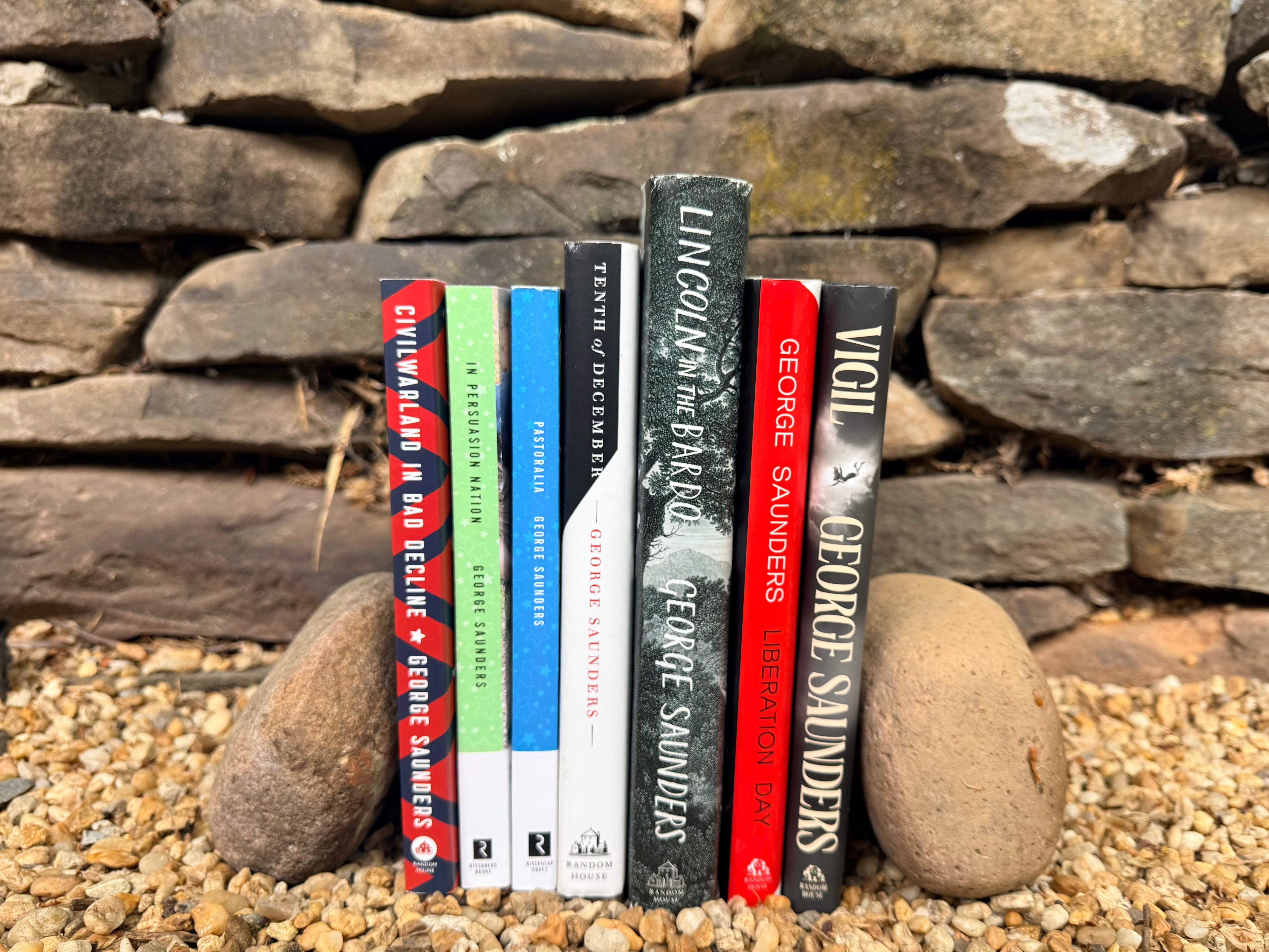
For the uninitiated of Vigil, Jill “Doll” Blaine descends toward K.J. Boone’s deathbed in her favorite black pumps, reconstituting limb by limb as she falls. She has been “elevated” and sent, decades after her own death by car bomb, to comfort the dying. Boone, her current charge, is an oil tycoon who knowingly poisoned the planet for fifty years and who, dying, has nothing to apologize for. Beside her at the bedside is the Frenchman, who invented the engine and has come to repent it, and who insists Boone be made to repent before any comfort is offered. Read quickly, Jill and the Frenchman look like opposites: she dispenses unconditional grace, he demands moral reckoning. Saunders himself, in interviews around Vigil’s launch, has wondered aloud who is right.
But neither of them are doing what they appear to be doing [SPOILER ALERT!]. The Frenchman has collapsed the contradiction toward moral binary: comfort must be earned. Jill has collapsed it the other direction: comfort must be given regardless. They have picked opposite sides of the same refusal. Jill’s ending—setting off for the next vigil, the human memories tucked underneath the elevated self as fuel rather than held in tension with it—is not synthesis. For her, it becomes an infinity loop. She has chosen and the choosing is the closure. The contradiction the novel wants held—that Boone is both monstrous and a man, that comfort is both warranted and obscene—is held by neither of them. Saunders refuses to redeem Boone for our comfort, not because he’s withholding, but because the unredeemed Boone is, of course, the thing he wants to think about with us.
The pressure of the novel lands on Boone and Saunders builds him with unsettling care. He is not a cartoon. He was a Midwestern farm boy who loved his wife, who raised a daughter who turned out caring and well-adjusted and who sits at his bedside in his final hours. He believes [actually believes; just like the current U.S. Secretary of Energy, someone whom I briefed a few times but that’s a story for another time] that the energy his company pulled from the ground lifted billions out of poverty and that the world is better for his having lived in it. He is also a man who knew, by the 1980s, what carbon emissions were doing atmosphere, and who spent the next forty years funding the lie. Saunders gives us both Boones in the same prose. Boone’s daughter is not a redemption. She does not undo the decades of deceit, but she is not nothing, either. She rearranges the pillow behind his head with the unembarrassed familiarity of a daughter who has done it many times before. Whatever Boone was outside this room, in this room he was a father who had taught a child how to love him without flinching. Something in him was capable of producing her. The reader is asked to do neither and both: to keep both Boones in view at once and to refuse the relief of choosing.
What makes Boone exceptional in Saunders’ catalog is that the loving husband and the well-adjusted daughter aren’t quite enough. They don’t soften the man, nor do they redeem him. But it does make the reader pause. Boone represents an evil so clear and obvious that he is worthy of our anger, and Saunders knows it. In a February 2026 conversation with Ezra Klein, an episode titled, tellingly, “George Saunders on Anger, Ambition and Sin”, Saunders described Jill’s compassion-for-everyone framework as one he largely shared going into the novel, but admitted he got more and more skeptical about it as he examined it. Saunders’ creation of Boone seems to have broken something in the formula. Saunders said he went into Vigil ready to extend his usual generosity to a flawed character. Yet he found in Boone an evil that his generosity could not absorb. The Frenchman, for all his hardness, is right that the anger is real and earned. Jill, for all her sweetness, is wrong to dispense comfort that displaces it. The reader is asked to hold both: the anger Saunders himself could not write past and the human being he refuses to reduce to that anger.
Saunders works skillfully in compression that accumulates and accelerates. Take a single sentence on pp. 172 in Vigil where he renders two characters and two contradictions at once. Jill, seeking a fresh beginning, hurls herself toward Paul Bowman—the man who killed her—and finds him “luminous, spectral, celestial, the size of a mountain, seated at that same (football field–sized) metal table, nervously smoking.” From the page, we understand this isn’t the first time she’s done this. The sentence is doing two characters at once. Jill has rendered her killer cosmic because she cannot approach him at human scale; her elevation-system is a coping mechanism dressed as enlightenment (photo from pp. 172-173 below).
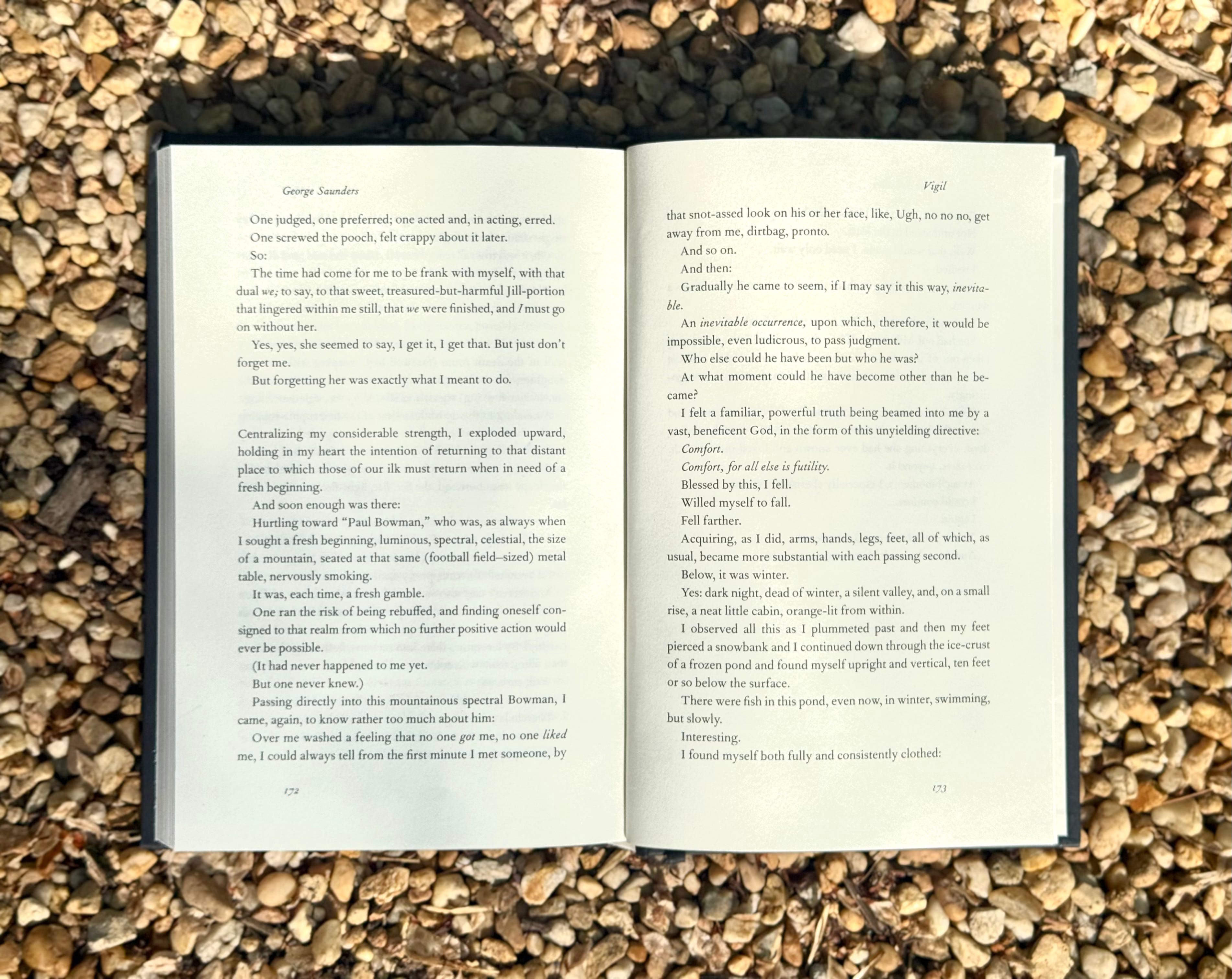
George Saunders, Vigil (New York: Random House, 2026), 172–173. Excerpt reproduced for purposes of literary commentary. Photograph by the author.
But Bowman is also there inside the prose. He is still, eternally, the man who needs a cigarette, unable to settle into the transcendence Jill is imposing on him. Jill collapses the contradiction toward elevation: he must be cosmic so I can approach him. Bowman collapses it toward the human: I am still the man at the table. They meet in a single breath and the reader feels both collapses simultaneously.
This is the kind of architecture Saunders has been building since he launched his career. Take “Al Roosten” from Tenth of December, which is perhaps my favorite Saunders story ever. [He just totally nails the characters + scene. The humor is so absurd. I still remember how much my whole body hurt after I read it in The New Yorker back in 2009.] In the story, Al kicks Larry Donfrey’s [an incredible name] wallet and car keys under the bleachers in a fit of envy and walks away. He considers himself, if not quite a hero, then at least a man who has been wronged and is owed something.
The premise runs through the entirety of the collection, including the title track, “Tenth of December”. Don Eber, walking into the woods to die before his illness takes his mind, has constructed an entire moral architecture around his choice. He wants to spare his family, exit on his terms, keep his dignity. Robin, the boy who falls through the ice, ruins it. Eber must come back, must be saved, must keep the body and the mind he was trying to spare everyone. The story refuses to tell us whether his decision to die was right or wrong, whether the rescue is grace or postponement. It holds both. The compassion that gets attributed to Saunders’ treatment of his characters is also, and maybe more fundamentally, a compassion for the reader he is asking to hold what the characters cannot.
The political register sharpens in Liberation Day’s “Love Letter,” where a grandfather writes to his grandson explaining why he and his generation did not act as democracy eroded around them. The letter is the contradiction made textual. He is composing his own moral self-portrait while the gaps in the portrait remain visible to everyone but him. The things he didn’t say, the meetings he didn’t attend, the small accommodations that became, in aggregate, the absence of resistance. He cannot quite see what he failed to do, and cannot quite not see it, and so the letter has to keep going. Stopping would mean acknowledging what the letter is actually for. Where Al Roosten kicks the keys and walks away mid-rationalization, the grandfather writes the rationalization onto the page in real time, and the prose forces the reader to hold both the man he is telling his grandson he is and the man the letter reveals. The grandfather is the necessary counterpart to Boone. Boone knew about the impact of carbon emissions and lied; the grandfather knew about democracy and did not act. One is the active agent of a knowable harm, the other its passive enabler. The contradiction the reader is asked to hold across both figures is the same: that knowing is not innocence, that the architecture of self-justification is itself a kind of harm, and that compassion for the man does not absolve the man.
Lincoln in the Bardo is the formal articulation that connects all of this. The bardo dwellers: Vollman with his unconsummated marriage, Bevins with his slit wrists, the reverend with his terror. Each refuse to know they are dead. Each has picked a side of their own contradiction and built an afterlife around the refusal. The chorus of voices, the absence of a single integrating narrator, the bardo as structure rather than mere setting—is the refusal of resolution. Vigil inherits that form, but tightens the moral stakes by making the unresolved figure actively guilty rather than tragically grieving.
What changes between the two is not the move, but rather the figure being held. Lincoln in the Bardo gives us a grieving father and a chorus of the dead, all of them holding contradictions about loss. Lincoln cannot let his son go; the bardo dwellers cannot accept that they themselves are gone. The novel’s moral atmosphere is sorrow, the radical cosmic tenderness that Saunders is so good at effectuating for the reader. Vigil narrows that chorus to two voices arguing across a single bed and replaces the grieving father with a guilty one. The contradiction the reader is asked to hold is no longer “how do we go on after loss” but “what do we owe a man who caused loss and feels nothing.” The scale changes to: Willie Lincoln’s typhoid is intimate and tragic; Boone’s lying about damage from carbon emissions is structural and ongoing and the harm has not stopped at his deathbed. Sorrow is no longer the governing register. Anger is in the room. The form has tightened from an orchestra into a chamber piece. To raise the stakes, the question has tightened from whether grief can be metabolized to whether anger can coexist with seeing the man whole. Saunders is doing the same move, but in harder material. He’s admitting into the work an emotional register that he sometimes kept at arm’s length.
There is a discomfort to all of this. Saunders does not let the reader settle. We cannot dismiss Boone. The daughter is there, the farm boy is there, the love for his wife is there. We cannot absolve him. The lying is there and the burning planet remains. We cannot let go of the anger he has earned and we cannot let the anger be all we feel. We cannot side with the Frenchman without becoming his hardness, and we cannot side with Jill without accepting her loop. Every escape route the story offers turns out to be another collapse of the contradiction it has asked us to hold.
What I think that stuckness produces, if we stay inside it, is a kind of forced widening. We have to imagine further than we wanted to. We have to extend ourselves toward Boone—not to forgive him, but to see him—and the extension is the work. Saunders’ compassion is not a posture he models for us. It is a muscle he develops in us by refusing every easier alternative.
P.S. If you aren’t subscribed to Story Club, you should be. George has built one of the rare genuinely kind, genuinely curious reading communities online, and his generosity with his own experience and craft and engagement with his readers is the engine of it. I’m grateful for every post.
Author’s Note: I am not paid by or affiliated with Politics & Prose. They’re just my local bookstore.