


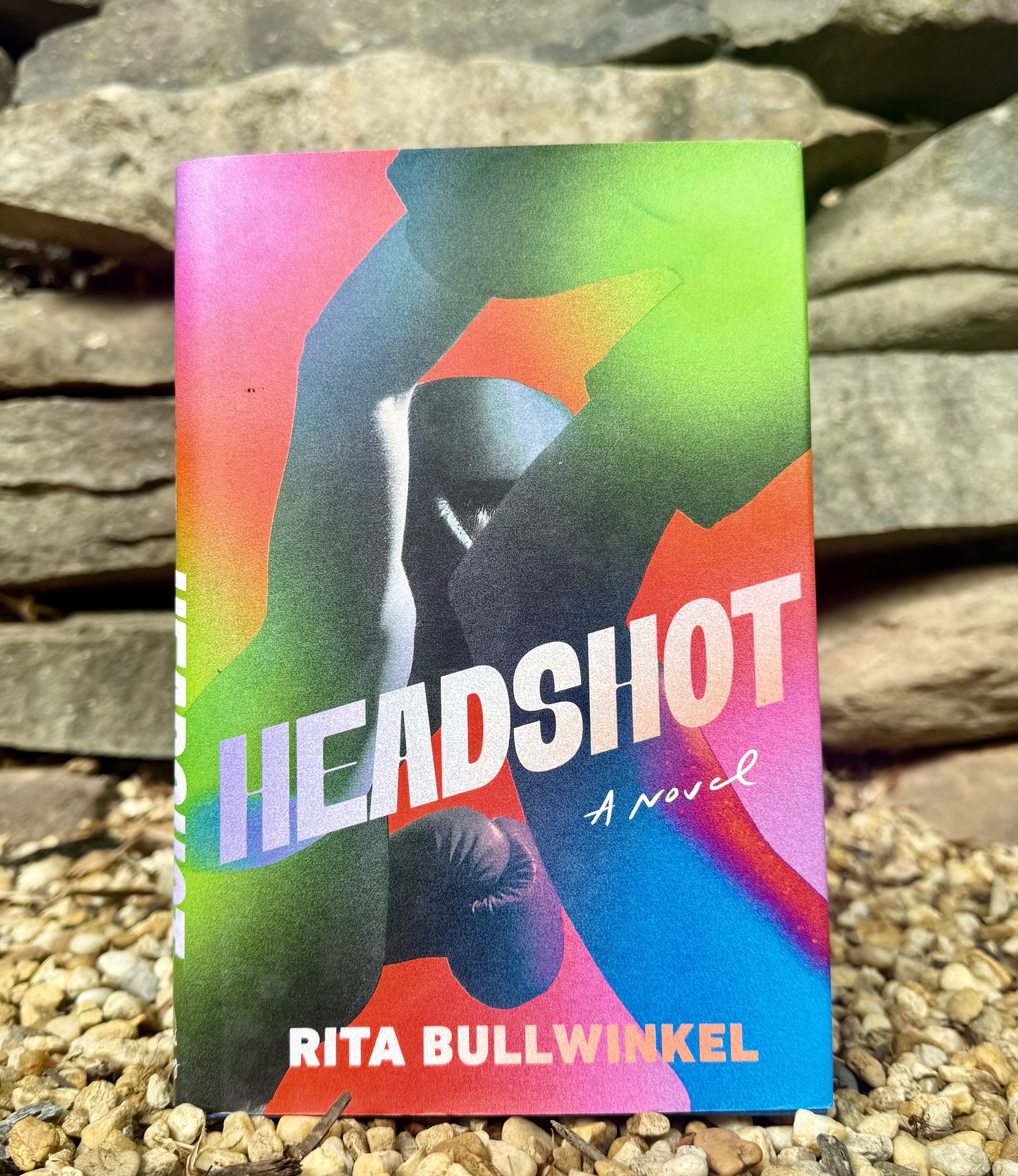
I read Rita Bullwinkel’s Headshot across two evenings earlier this year and finished with a kind of hangover. It wasn’t the soft afterglow or disbelief that good novels sometimes leave, rather something physical—the experience of having sat front row at Bob’s Boxing Palace, my body still in those folding chairs after the book was closed, the matches replaying in my mind. Bullwinkel’s debut novel—longlisted for the Booker, a finalist for the Pulitzer—does something I’ve worked with in my own fiction: holding a single bounded event together while rotating consciousness across multiple characters. Headshot is set at the 12th Annual Women’s 18 & Under Daughters of America Cup, an amateur boxing tournament held over a single July weekend at Bob’s Boxing Palace, a converted warehouse in Reno, Nevada in the year 20XX. The novel features eight teenage girls competing in seven bouts to crown one champion.
I closed the novel with questions I could’t let go of. Why are these girls unable to stop thinking about the things they cannot stop thinking about—the lifeguard chair, the locked shed, the older sisters? What does a tournament mean once you already know how each girl’s life will turn out decades later? What is the body permitting the mind to do during a fight that it cannot do anywhere else? I want to take these questions seriously, which means starting with how Bullwinkel constructed her work to ask them.
The sports novel is the most teleological form fiction has. Most scenes in a sports novel are tributaries to the outcome the form was built to deliver. There is a lineage of books that lean into this—Malamud’s The Natural, Chad Harbach’s The Art of Fielding [a personal favorite, and a book that takes the form’s outcomes seriously enough to let them devastate]—and a counter-lineage that strains against it: Leonard Gardner’s Fat City, Alan Sillitoe’s The Loneliness of the Long Distance Runner, DeLillo’s End Zone, Tim Krabbe’s The Rider [another personal favorite, recently called by Patrick Redford in Defector the best sports book he’s ever read]. And who can forget Infinite Jest. Headshot belongs in the second camp, but it does something none of the others quite do.
Headshot preserves the tournament bracket’s scaffolding while doing the opposite of what the form normally does. The fighters arranged in the bracket enter the tournament with their past, present, and futures assembled: the girls are spit out into futures where the tournament either mattered or not at all, and they cannot tell from inside the ring which kind of moment they are inhabiting. The novel also wades into the weird (and pernicious) world of the youth sports industrial complex. [I’ve had the privilege of having been a participant AND an intrepid carpool driver for this Glorious Modern American Pastime.] Most of the fighters have traveled from far reaches of the country—with their parents, grandparents, or on their own, sleeping in the car along the way—in quest of an achievement they hope will recast their lives. The novel is built to register that gap, a form being part of the argument.
Joyce Carol Oates, in On Boxing (1987), wrote that “each boxing match is a story — a unique and highly condensed drama without words.” What Headshot has, in place of dialogue, are two narrative voices: a close third that lives inside each girl during her bouts, and a contemplative-omniscient voice that pulls back to the bracket and to the years before it and beyond it. The friction between those voices is the engine of the novel. Three craft mechanisms make it run.
Body as alibi
In the close-third sections, the body has to keep moving—bell, round, jab, step, parry—and the mind is freed to refuse forward motion. The physical task is not a competing demand on the character’s attention. It is the occasion for ruminative material no other narrative situation could so naturally accommodate. Andi Taylor, mid-bout, returns to the lifeguard chair where a child drowned on her watch. Rose Mueller carries the shed her family locked her in as a girl. Artemis Victor cannot stop comparing herself to her sisters. Bullwinkel said this almost directly on NPR: when you use your body for something difficult, your unconscious goes to uncontrollable places, and the things that haunt you come to the surface. The boxing is not the interruption of the haunting; it is what makes the haunting available.
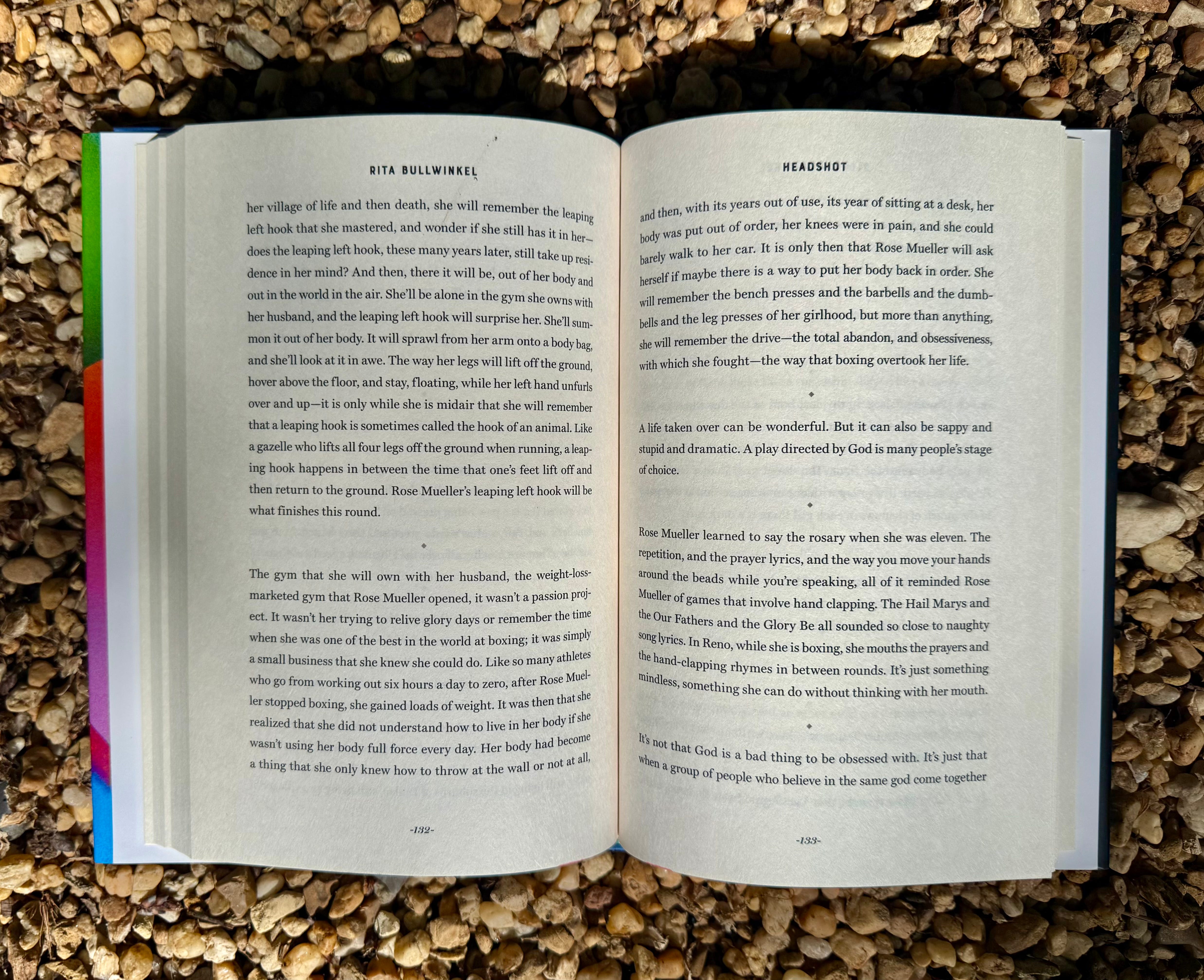
Rita Bullwinkel, Headshot (Viking, 2024), pp., 132-133. Excerpt reproduced for purposes of literary commentary. Photograph by the author.
Rendering thought during action or activities of heavy concentration requires precision on the page. In my own fiction, I’ve found the action can grind to a halt the second the thinking gets interesting. One of my novel’s main characters is an alcoholic who builds intricate furniture. It took many revisions to strike the balance between the character’s physical action—sanding, applying a coat of polyurethane, mortising a joint—and an internal monologue about what he feels while doing it while also folding in memories. The trick is the wider consciousness underneath both, and not letting any of the three overweight the others. What’s interesting to me about Bullwinkel’s novel is that her solution is structural rather than rhetorical: choose a sport whose physical demands are so total that the mind has no choice but to wander, and then trust the wandering. It works because boxing is the rare athletic context in which sustained interiority is plausible. The fighter has to be elsewhere; her body is doing what bodies do under threat, and her self has to live somewhere it can survive.
The voice inside the bracket
The omniscient sections are where Headshot’s strangeness lives. The register is the thing to name carefully. It is mythologizing, but loftier and more interior than a play-by-play. While there are some elements of play-by-play, it does not reach outward for grandeur the way the great American sports-documentary voices did. If you want the contrast in their ear, here is John Facenda narrating They Call It Pro Football in 1967: Frozen tundra! Pirate winds! Full Wagnerian football mythology! [I’d embed the YouTube video, but alas the NFL’s copyright rules prohibit so onward.] This voice is the zeitgeist of American sports culture. This is not what Bullwinkel does. Her voice gets grander by going deeper. It pulls back from the action and asks the kind of questions about repetition and pattern and consequence that the girls themselves are too inside-the-moment to phrase. In a late bout the narrator catches the form in the act of betraying itself: “there is the implication of a loop, or the suggestion of a repetition, a circular groove within which the tournament has fit its narrative.”
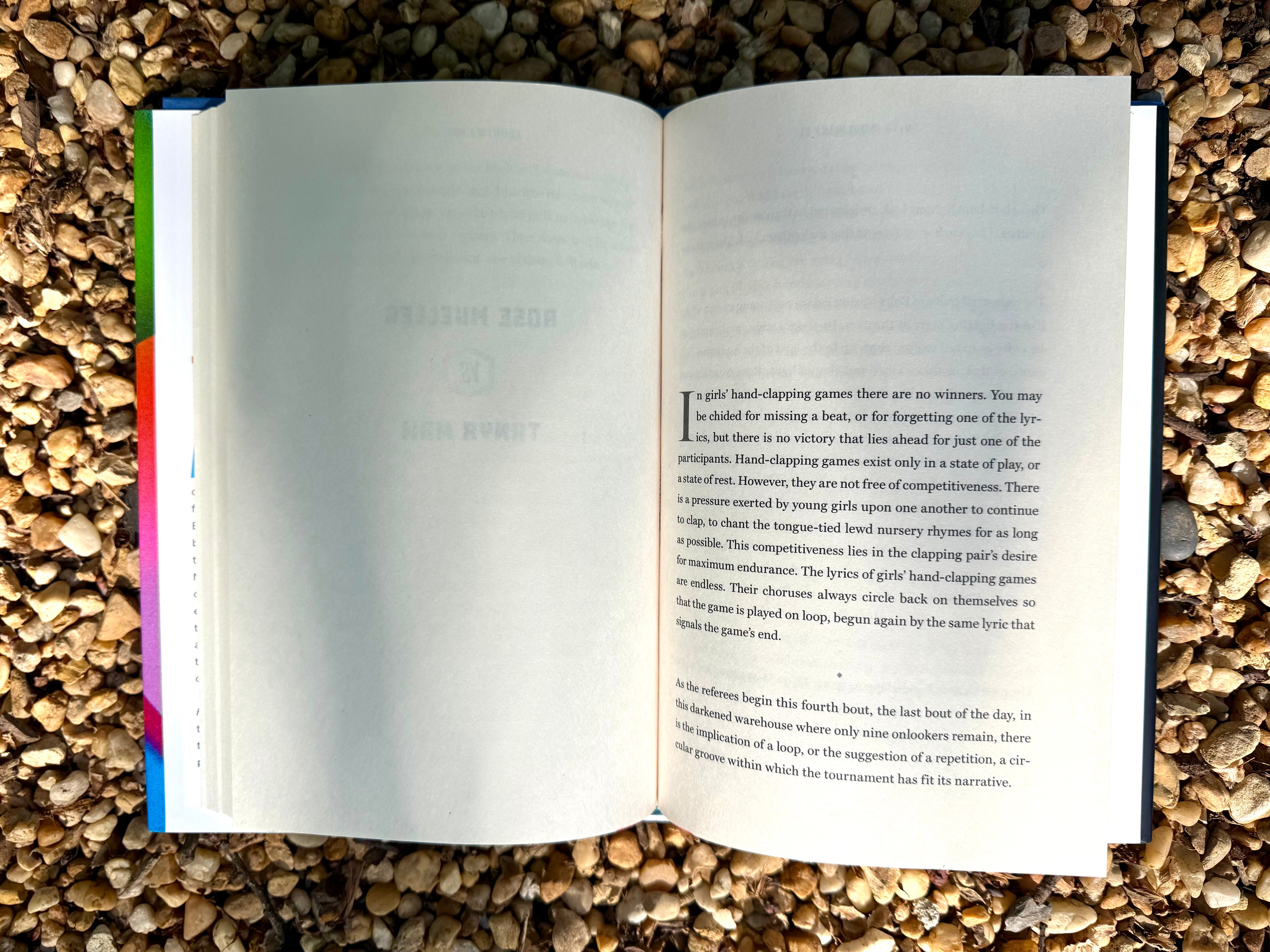
Rita Bullwinkel, Headshot (Viking, 2024), p. 117. Excerpt reproduced for purposes of literary commentary. Photograph by the author.
Words like implication and suggestion are doing real work there. The voice is uncertain at altitude—authoritative in its distance but still working something out, in the register of meditation rather than commentary. This is the contradiction the second voice generates. Brackets promise whittling. Many becomes few becomes one. As the boxers advance, they do not become more singular; they accumulate the consciousness of the girls they have defeated. Bullwinkel told Lincoln Michel for an interview in Counter Craft that the structure had to “fold in on itself in order for it to continue to build suspense.” The omniscient voice is not the bracket’s voice, rather it is the voice dismantling it within.
The Bob’s Boxing Palace time vortex
Bob’s Boxing Palace is a converted warehouse in Reno. [It’s basically a venue Phish would have played in the early 1990s—hello, Bomb Factory in Dallas, ‘94.] It has folding chairs and bad light and a styrofoam quality I want to insist on—cheap, off-brand, materially provisional, unaging. [This contrasts with the millions of taxpayer dollars spread across the United States to build gargantuan soccerplexes, basketball stadiums, natatoriums, baseball fields, et al in its own bracket of national economic development glory.] The point of Bob’s Boxing Palace is that it can still serve the purpose and offer the promise of these other places precisely because of the illusion of opportunity. Bullwinkel set the book in 20XX, she told Lit Hub, because she wanted it to take place outside of time. The warehouse is how she makes the year hold. A more specific setting would betray time. And a more storied venue—Madison Square Garden, the MGM Grand—would carry its own historical weight and force the book into more of a reality. Bob’s Boxing Palace is generic enough to dissolve. And that dissolution is what allows the incompatible time-registers to operate simultaneously inside the same building.
There is the bracket time: linear and forward-driving, winnowing the fighters down from eight to four to two to one. There is the fight time: the present-tense pressure of a single round in which a second can hold a calculation or a memory or a lifetime. There is the loop time of the close-third interiors: recursive and refusing the present even while inhabiting it. And there is the flash-forward time: delivered by the omniscient voice, decades ahead. The contemplative voice is the agent that has access to all of these at once and grants them to us simultaneously, so that the bouts the girls are pouring everything into arrive at the reader already half-undone. The champion does not become famous. The losers do not stay losers. We are reading toward outcomes the book has already disclosed: outcomes that will not matter the way the bracket assumes they will.
What the bracket can’t decide
Most sports novels have to land a verdict, if not a champion. By the final bout the form has arranged its material so the meaning is clear: either the right girl wins, or the wrong one wins and we understand what was lost. Headshot refuses this transaction. There is a winner, but the championship is not the meaning. What the novel delivers instead is accumulation: eight consciousnesses we cannot finish thinking about, futures that arrive before the bouts conclude, a warehouse that holds incompatible times at once. The match Andi Taylor is fighting against Artemis Victor is not just with Artemis. It’s with her past and future. There is another reading under the surface. How did these eight girls come to be in this room at all? What about their agency and wanting and inheritance got them there? What does the protection of one’s own ambition cost?
Back to the hangover. The mechanism of it, I think, is that Rita Bullwinkel gives the reader eight girls in a structure compressed enough that you finish each chapter wanting the novel that could have been written about just her. The form generates an appetite it refuses to satisfy. You leave with eight unfinished hungers and no way to address them. This is the lesson that I am taking back into my own fiction: the present moment we are most intensely inside is almost never the moment that turns out to have mattered, and we cannot tell, from inside it, which kind of moment it is.
For the record, I was rooting for Iggy.
Author’s Note: I am not paid by or affiliated with Politics & Prose. They’re just my local bookstore.