


Most of us choose our passions and interests—the things we want to give a life to. What we can’t always choose, or perhaps choose only in the loosest sense, is the path that devotion takes once we’ve committed to it [sometimes you must write while sitting in the bleachers of your child’s swim practice]. The milestones rarely arrive how or when we expect them, the relationships that surround the work get assembled half by accident, and the losses and setbacks, when they come, come on their own schedule and rearrange us without our consent.
Lily King’s two Casey Peabody novels, Writers & Lovers (2020) and the very recent Heart the Lover (2025) take this jaggedness seriously rather than treating it as a failure of will. Read together, the novels make an argument easy to mistake for one about literary ambition and a life committed to making art. While ostensibly about relationships and love, the novels are really about grief’s permission structure. In my experience, grief deflates our gladness and saps more of our agency than we realize.
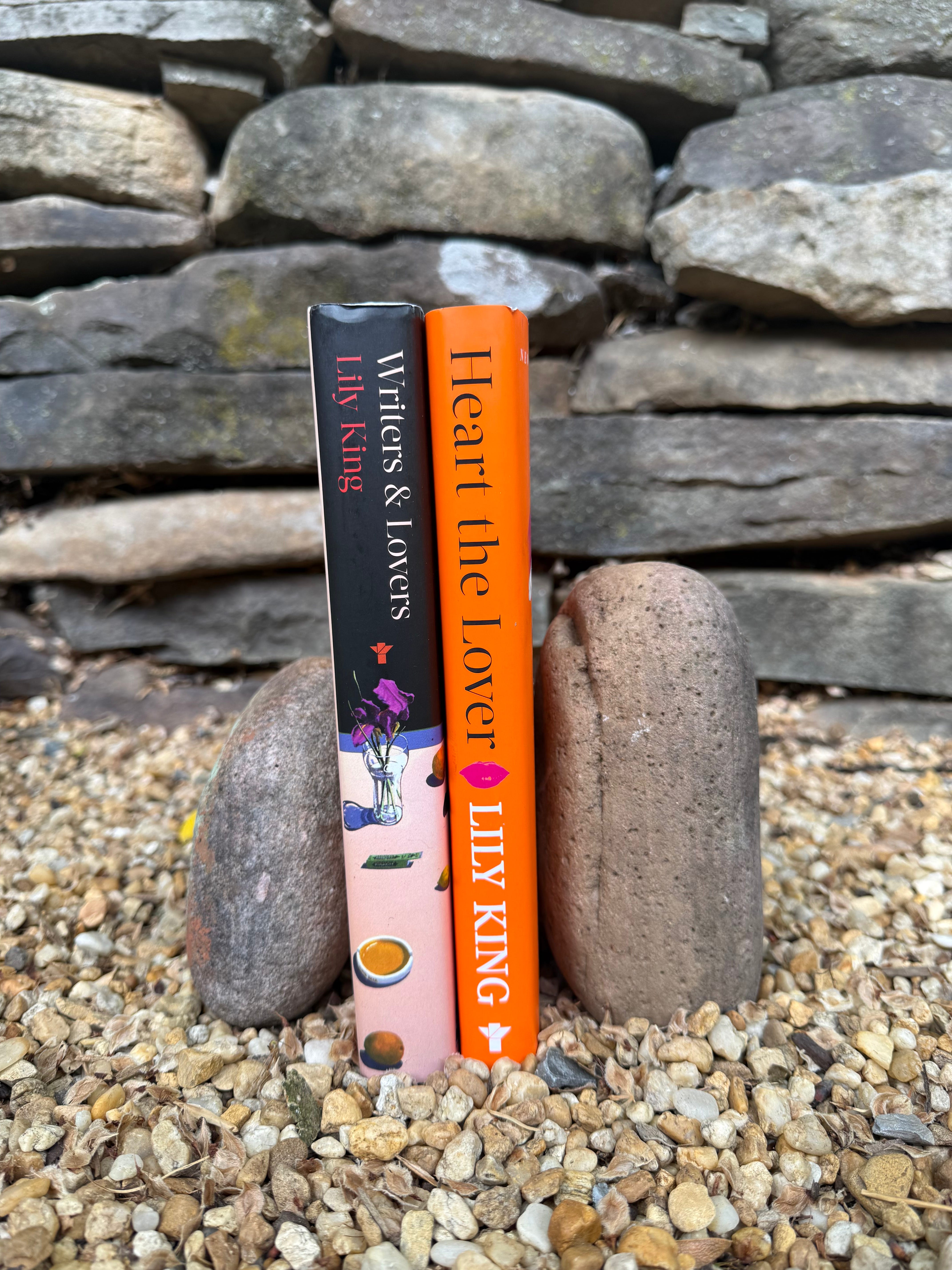
In rendering Casey Peabody [SPOILER ALERT!], King has given us a protagonist for whom almost nothing in her life is something she has chosen. Her mother dies suddenly on a trip to South America under circumstances that remain only partly understood. Her father, earlier in her life, lost his high school coaching job after he was caught looking through a peephole at teenage girls in a locker room. Casey and her brother Caleb drift through Writers & Lovers in a semi-fugue state, unable to reconcile with the family that dissolved. The only act left available to them is the refusal to make any further choice. The not-choosing seems to be the closest thing to agency a mind broken by a death it couldn't prevent can manage.
Crucially for Casey, inside that drift, there is the writing: six pages a day kept up for six years on a single novel, done in the morning hours before her restaurant shift. By coincidence or design or synchronicity, both novels place passages I kept returning to at pages 80-81. In Writers & Lovers, Casey describes the practice itself: “The hardest thing about writing is getting in every day, breaking through the membrane.” The line sits on the page facing the news of Princess Diana’s death—public grief on one side, private discipline on the other—and it gives the defended-corner argument in Casey’s own words. King has said in a 2020 Dead Darlings interview that Writers & Lovers poured out of her after her mother’s death, when she had been unable to write anything for a long time. Of course, this is essentially what the writing is for Casey too: not a triumph of will but the one practice that survives the unmaking.
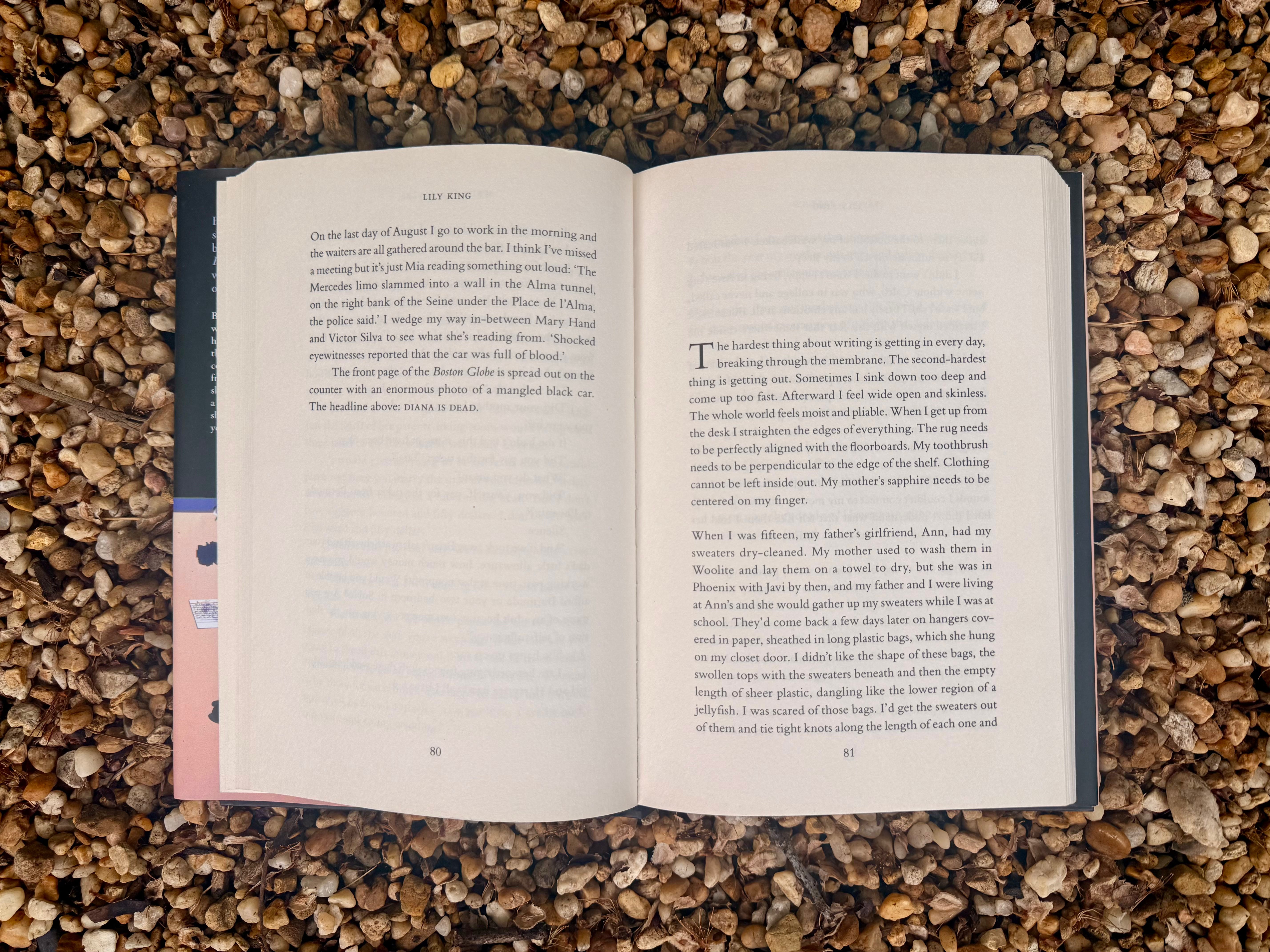
Lily King, Writers & Lovers (Grove Press, 2020), pp. 80-81. Excerpt reproduced for purposes of literary commentary. Photograph by the author.
The mirroring page 80-81 in Heart the Lover shows Casey doing what a writer does, which is to see. Yash, back on campus, has come to find Jordan (a nickname given to her by Sam and Yash), and they have a conversation about reading each other’s work. She tells him his story was gorgeous and tender, that the writer in it “sort of reminded me of” him. He dismisses it as maudlin and overwritten, then hands her a paperback of Knut Hamsun's Hunger and tells her it is “about being a writer, no matter the cost.” She holds back the deeper thing she sees in him, because what she sees is him, and the words won’t come. He gives her the framing for the vocation they are both already practicing. He does not quite give her himself.
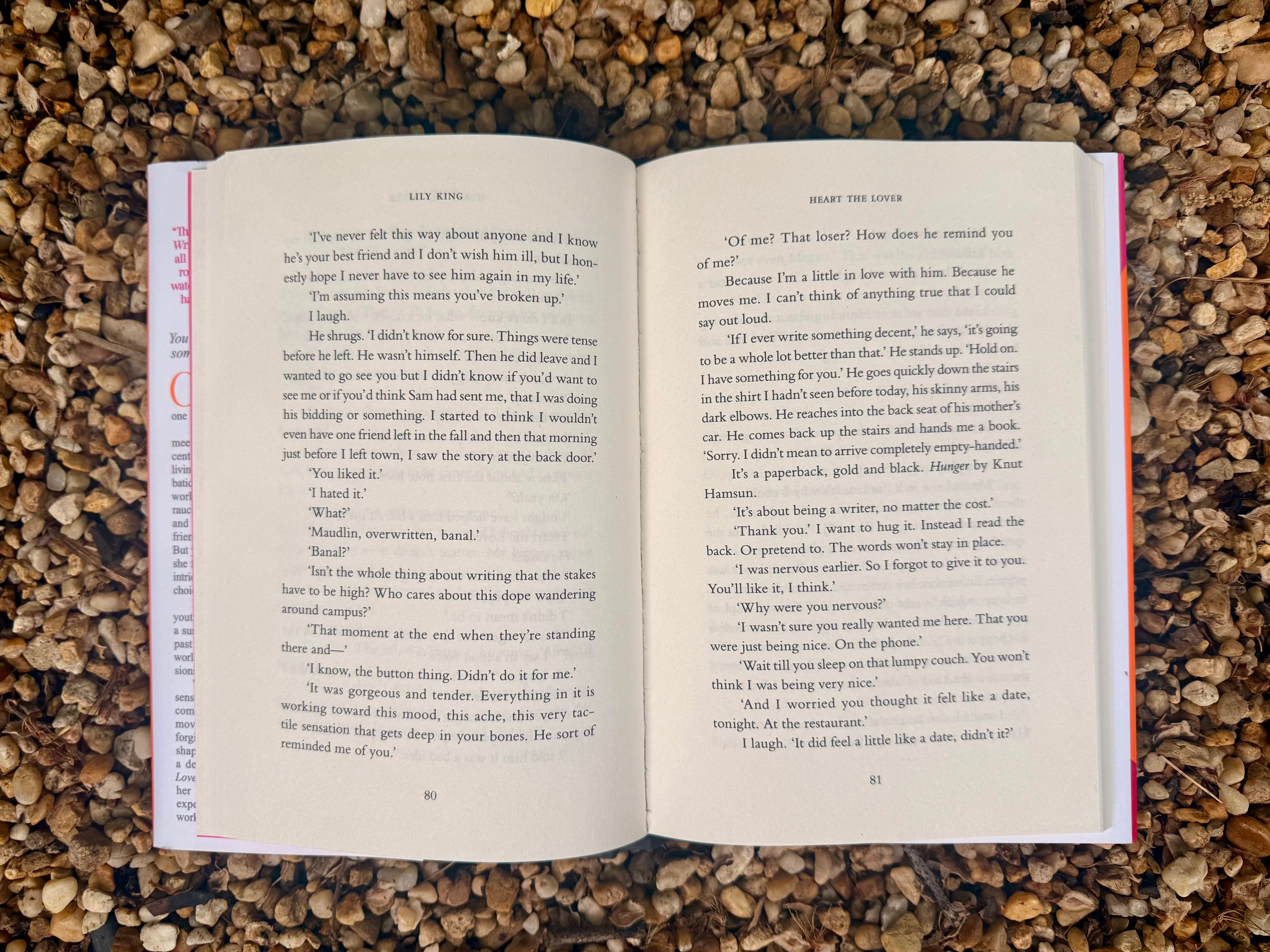
Lily King, Heart the Lover (Grove Press, 2025), pp. 80-81. Excerpt reproduced for purposes of literary commentary. Photograph by the author.
While Casey manages to claw out a space for her writing within the drift, the drift’s seems to overwhelm nearly every relationship Casey is in. Paco, Luke, Oscar, Silas, Sam, Yash—the six men across two novels set the romantic rhythms Casey lives by. Around them a wider weather of relationships she inhabits rather than chooses: the landlord whose apartment she takes because it is offered, the kitchen staff whose orbit she joins because the job is there. She follows Paco to Spain on something close to a whim, uprooting her whole life on the gravity of one man's pull. As the older Casey in Writers & Lovers, she dates Oscar and Silas in parallel, drifting between them as circumstances (joining an already formed family versus building one), rather than her own desires seem to decide. As a college senior in Heart the Lover, she is pulled into Sam and Yash’s orbit, loses Sam to a breakup, and is then crushed when Yash, on the eve of their planned move to New York together, chooses his loyalty to Sam over his love for her. Maureen Corrigan, reviewing Heart the Lover for NPR, observed that the Yash wound is the engine of the older Casey's arrested development, another grief inside the larger one—and the formulation extends past Yash to all of them.
What grief has done to Casey is more particular than the deflation of agency in the abstract. The wounds at the center of her life are wounds of regard—a mother who could no longer hold her in mind because she was dead, a father whose attention turned out to have been the wrong kind all along. What Casey lost was the experience of being chosen, chosen to be looked after, chosen to be seen rightly. The posture she takes toward the men is not passivity. It is the specific shape of waiting to be chosen again, because to choose first would require trusting she could survive choosing wrong. [The latter is why, I think, King’s novels land so powerfully on the reader. Unless you’re hermetically sealed off from the world, every reader can relate to the notion of how fear drives us away from making a choice.]
The first crack in this pattern comes late in Writers & Lovers, when Oscar returns from a work trip in a foul mood and expects Casey to absorb it—after caring for his boys for the weekend, no less. She refuses, leaves the house, and does not go back. The refusal is small in the scale of a life, but it is the first time she declines to organize herself around a man’s weather. Everything that follows in Heart the Lover later is built on the ground this exit clears.
Charting Casey’s arc across the two novels, King manages to do something quite bold in that she takes a rather conventional climax setting (a deathbed plot) and turns it on its head. The hospital room in Heart the Lover makes the climax possible rather than being the climax itself. Yash is dying and Sam is keeping vigil when Casey goes to them, and what she is given there is the chance to do for Yash what she was unable to do for her mother years earlier. She’s present at the ending rather than receiving its aftermath from a distance. The agency she was denied at the central wound of her life is partly returned to her here, in the smaller form of choosing presence at someone else’s wound. It isn’t redemption, since Yash still dies and her mother is still gone, but being there is something Casey chose for herself, and the choosing is what opens the door to the final moment of the book.
The deathbed scene also sharpens what the writing has been arguing all along, giving Casey the comparison she didn’t know she was making. Sam and Yash are the brilliant boys whose essays the professors read aloud, and everyone assumes they will be the writers. By middle age, it is Casey who has become the writer and the brilliant boys who have not. The hard life of writing doesn’t yield to kindness; it tends to find the people already practiced at keeping going—even inside loss.
After everything the two novels have piled up against this moment, Casey is finally and completely seen. Silas in that closing moment is at once the partner she has built a life with and the father she never had, present and generous and capable of recognizing exactly who she is, and the wound that began with her own father is met, in this last image of the book, by a man inhabiting both roles at once. This is what the agency King has been tracking has been moving toward all along: not Casey directing her own life, not even Casey choosing presence at someone else's ending, but Casey at last being witnesses by another.
What King refuses, in both novels, is the rationalization—the consolation that grief makes Casey stronger, the argument that loss is a teacher. The novels are not scaling the tired mountain of personal resilience and grit, which I admire. What they do instead is leave something in the reader, a residue that allows us to look at the hard moments of our own lives. The line I opened this essay with—that grief deflates our gladness and saps more of our agency than we realize—is not a claim I came to King to argue. It is something her writing made visible to me about my own. The deepest subject here, as Mary Kate Carr observed in her AV Club review, is what it means to be known by another at a particular moment of your life, and being known is itself one of the small choices grief still permits—alongside the morning hour at the desk, the trip to the hospital room, the willingness to be loved at last by someone who can show up.
Epilogue
The butterflies on the summer breeze
The wildflowers sway with ease
At the bridge of two infinities
What’s been lost and what lies waiting
— Big Thief, “Double Infinity” (2025)
Big Thief’s ‘Double Infinity’ was in my ears while I was drafting. The bridge image kept rhyming with what I found in King’s novels.
Author’s Note: I am not paid by or affiliated with Politics & Prose. They’re just my local bookstore.