


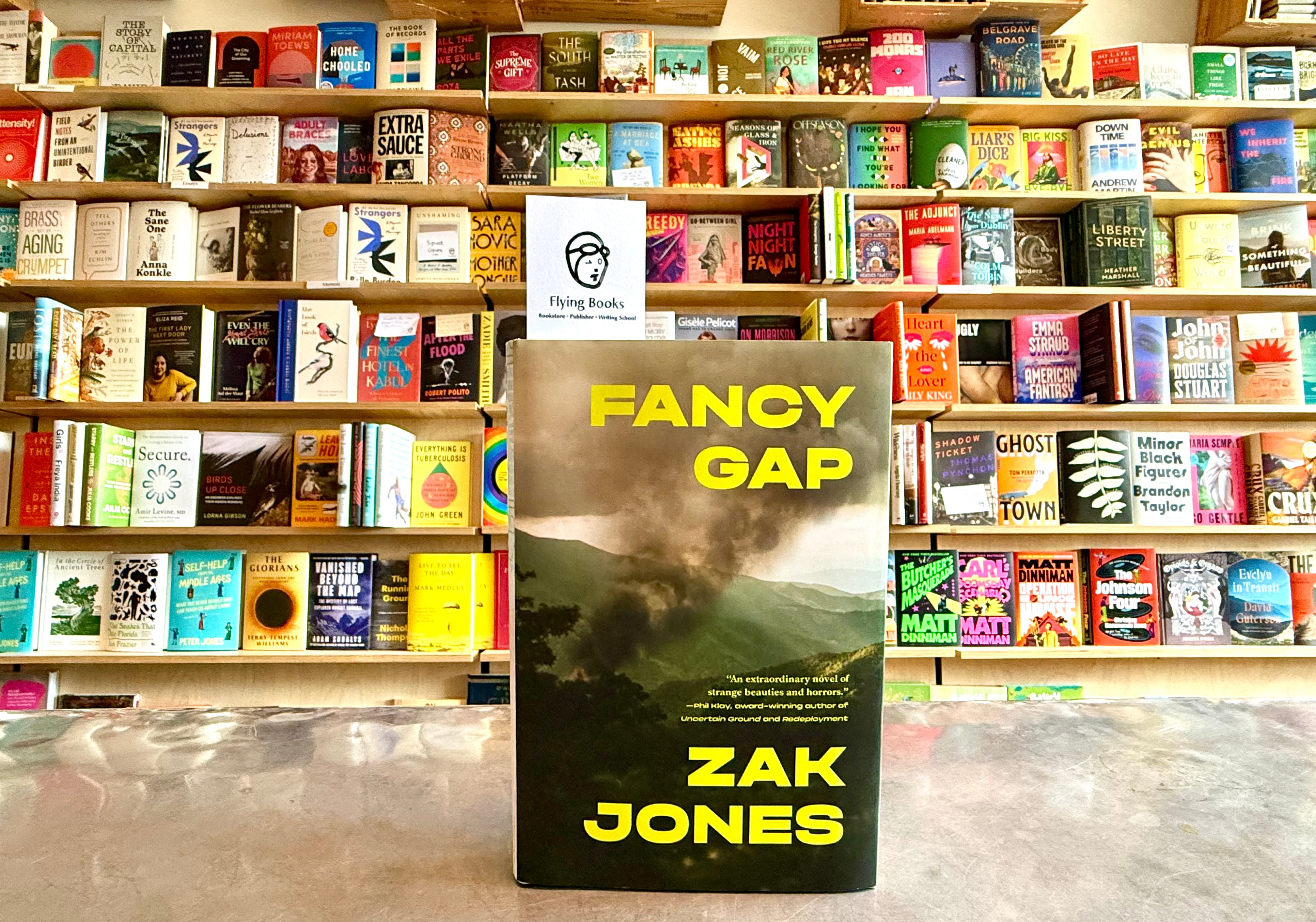
I picked up Zak Jones’s debut novel Fancy Gap (Hamish Hamilton, 2026) a few weeks ago at Flying Books at Neverland, on Queen Street West in Toronto, on a sticky-note recommendation from the staff and a read of the first few pages. As a writer with my own polyphonic multigenerational novel, the Fancy Gap’s premise also spoke to me: three generations of a family in rural Appalachia threaded through addiction, poverty, illness, fraying bonds of family, and the entrenchment of misguided faith. The staff recommendation, the voice in the prologue, and the premise were more than enough to tuck the book under my arm and keep browsing. The booksellers had a look of delight when I brought it to the counter with the acknowledgment that the novel delivers.
Nowadays, writing or making any art about Appalachia can be fraught, throwing oneself straight into a thicket in the holler. For the past decade, American culture has decided the region is one of the places it needs to understand. The body politic produced the urgency and the mainstream media produced the response through a steady accumulation of films, TV series, and books [I made it two chapters into That One Memoir before abandoning it underwhelmed] promising to render Appalachia (and rural places more generally) for the population who had been startled into curiosity. Even the most ambitious of these books arrived with their frames already assembled: opioid statistics, an extractive economy that collapsed inside a few generations, the cultural shorthands that purport to do the work of both locating a population and dismissing it.1 The reader is given the texture of the place and given alongside it the explanation that attempts to translate the texture into something familiar to them. What gets lost in this overgrowth are the conditions under which a reader could be said to know anything about the people who live there.
This is the tangle into which Fancy Gap was published, a novel that on its surface occupies every square inch of the territory the shorthand has already mapped. Three generations of the Fuquay family in the borderland between rural Virginia and North Carolina [a stunningly beautiful region, particularly around Mt. Rogers; one that Philip Lewis’s The Barrowfields approaches from a different angle]. Grace, the grandmother and self-made evangelist, dispensing fiery sermons and her own version of alms to her mountain flock. Her daughter Jane, dying of breast cancer and required to be grateful for the frivolous care of the church she attends. Dalton, the eldest son, discharged from the Army under Other Than Honorable conditions for a violation of Don’t Ask, Don’t Tell. [Dalton is discharged from Fort Drum, an Army installation about an hour from where I grew up—a small synchronicity.] Messy, the younger brother, shuttled between Bible camps and foster homes, building a moral code entirely in response to the environment he was reared in. By every available metric of subject and setting, Fancy Gap should be the novel the cultural moment expects. It doesn’t.
Jones doesn’t avoid the material the shorthand has claimed. The carcinogenic rivers, the apocalyptic preaching, the firearms, the tacky gas station paraphernalia, the big trucks with dualie wheels and floodlights are all in the prose without flinching and approached with sincerity. What he refuses is the position the shorthand asks a reader to occupy in order to consume that material. Fancy Gap will not let you stand where you would need to stand in order to know these people the way the shorthand has trained you to know them. The form is an argument about what a reader is allowed to know before they are allowed to judge.
How Fancy Gap earns the readers’ attention
There are three structural moves the novel makes that should be considered together.
Rotating consciousness. Fancy Gap moves among Grace, Jane, Dalton, Messy, and Clyde in short, close-third chapters. You, my dear reader, are rarely inside any one of them long enough to settle. As soon as the perspective hooks you, the chapter ends and you are somewhere else.
Withheld judgment. Each character is rendered without the narrator’s moral commentary. Grace’s drug-dispensing evangelism, Dalton’s flights from everywhere he finds himself, Messy’s warping into something neither the reader nor the family quite recognizes by the end—Jones does not editorialize. And he doesn’t arrange the material so that the editorial work is done by implication either.
Off-page development. The major changes in each character happen between the chapters that follow them. Messy’s transformation, Dalton’s drift between jobs and across regions, the deepening of Grace’s self-radicalization—the reader experiences the consequences of these arcs, but not the arcs themselves. The reader returns to the character and they have moved, and you were not there for it.
What these three craft choices do together is something none of them can do on their own. The reader’s experience of being pulled away from each character mirrors the family’s experience of being pulled apart from each other. The changes that happen in your absence is how it happens in theirs. Jones’s construction of Fancy Gap makes you a participant in the abandonment. You leave Messy in a Bible Camp; the family left him there too. You leave Dalton aimless and trying to outrun his shame; that is also what his mother did to him, what the Army did to him, and what he then does to Jane in turn. Rather than describing the abandonment, the structure enacts it.
On the other side of the brambles, I found Zak Jones’s Fancy Gap instructive in four ways.
Sufficient interiority and the right to blame
In fiction, providing a sufficient amount of interiority can produce the illusion that a person’s inner life is the cause of their condition. The longer you sit inside a character, the more naturally her circumstances begin to look like the externalization of her psychology, rather than the other way around. This is one of the things sustained interiority is for. Jones approaches building his characters’ inner life in an interesting way. The novel isn’t emotionally cold nor filled with endless pages of psychological spoon-feeding. He doesn’t freeze the reader out, rather he demands active empathy by refusing to let interior rumination serve as a substitute for feeling, action, and consequence among his characters. He doesn’t keep the reader in Dalton long enough for you to mistake Dalton’s interior for the reason Dalton’s life has become what it has become. He will not keep you in Grace long enough for you to feel you have the standing to call her a monster, or a tragic figure, or any other of the categories the cultural shorthand stands ready to supply.
The withheld judgment for his characters is not meant to be a totally sympathetic gesture. It is epistemic. The novel, I think, is making a claim about what you have to know before you are allowed to assign responsibility. This is the answer to the disconnect the opening paragraphs of this essay was trying to name. The failure of the cultural shorthand about Appalachia is, at root, an epistemic failure—a way of knowing the region without ever quite experiencing it. Jones’s form is a method for the opposite operation. You see the place. You see these people inside it. But the construction of Fancy Gap will not let the reader mistake the seeing for understanding. It will not let the reader mistake the understanding gained for the right to judge.
The inheritance the form breaks
Once you see the mechanism of withheld judgement, the novel’s relationship to the frame of inheritance starts to take on a new meaning. Fancy Gap, on one available reading, could be read as a prodigal-son novel with Dalton as the wanderer and the family as the unstable ground he keeps trying to return to. But the prodigal parable depends on the assignment of shame. One son strays, one stays, the family restores the balance. The shame is necessary as the parable cannot do its work without it.
Jones does employ the shape of the parable, while also rejecting it. Both brothers hold the shame, and neither gets to be the clean victim. Dalton’s return home is its own failed prodigal arc in miniature: he comes back and eventually he runs. The very moment the parable’s structure exists to consecrate is the moment Dalton cannot face. Messy, meanwhile, was never the brother who stayed. The family abandoned him to the care of other people and eventually foster care; whatever moral standing the parable would grant the home-keeping son, Messy never had. By the end of the novel, his anger has taken on a shape that is not simply reactive; it is its own failure and parallel to Dalton’s.
The forebear and the celestial
Fancy Gap has a prologue and an epilogue. It’s a risky device. The bookends can seem to readers as a thumb on the scale, or create a frame that the novel cannot earn from inside. I considered both for my own novel then decided against it given it ran the risk of diluting and distracting from the main characters stories. Fancy Gap earns it by making the two voices asymmetrical and structurally unalike while employing distinct registers. Both operate as two moons the rotating realist machinery in the body of the novel cannot contain.
The prologue is the voice of the grandfather, who is not present in the body of the novel. He’s the figure whose absence the family is already living inside by the time the first chapter opens. He is the man who, while he was there, seemed to have held the center together and for one chapter he speaks. The novel proper is what happens after this voice goes silent. The rotating consciousness can be interpreted as the form the family takes once that center is gone. The prologue does not give the patriarch back. It shows the shape of what happens when he leaves. The epilogue is the other edge of the same operation. After the final chapter, the epilogue places the four of them together in a register that is unmistakably celestial with dreamlike prose. Gone is the realist machinery the novel has been running for hundreds of pages. It’s the end state of the apocalyptic deliverance that Grace promised.
The two bookends work because they describe the shape of the wound the middle pages live inside. One edge is what was there, while the other edge is what the family and the flock cannot stop reaching for. The prologue and epilogue don’t soften the novel’s argument. Rather, they create the negative space the argument requires in order to be visible. The novel itself becomes a kind of interstitial place that Jones himself described as an inspiration for the project.
Sweep versus condition
It is impossible to write about an Appalachian novel without mentioning Barbara Kingsolver’s Demon Copperhead. [The novel is probably a masterpiece and a masterclass in creating a distinct voice.] Both novels take Appalachia seriously as a place, refuse the easy condescension, and render the texture of poverty and lived-experience of addiction with empathy and precision. Kingsolver and Jones are asking the same question: how do people end up this way? But each novel takes structurally opposite approaches.
Kingsolver’s answer is causation. Demon Copperhead is a Dickensian sweep through a single first-person voice across years and decades, accumulating the path that produced the person. The reader experiences the conditions become the boy, and the boy becomes the man. Jones’s answer is the condition itself. Fancy Gap does not show you the entire path that produced Dalton or Messy. It shows you these people inside their situations, present and gritty, and gives the reader fragments to reconstruct the path. Causation and condition are both legitimate answers to the question, but they produce different works and different demands on the reader. Kingsolver’s reader leaves with a kind of explanatory power. Jones’s reader leaves with the opportunity to be inside a situation he or she has not been permitted to explain.
What the rotation makes teachable
What I took from Zak Jones’s Fancy Gap reinforces what I have been working with in my own fiction: the moment your form makes a claim about what kind of knowing is possible inside it, every other choice you make either honors that claim or betrays it.
Fancy Gap honors its claim with a discipline I have rarely seen in a novel. The rotating consciousness isn’t just stylistic. It acts as a moral mechanism for how we hold the multitudes within the characters and, by extension, the people around us in our lived experience. The withheld judgment is not just a sympathetic posture, rather it operates as an epistemic limit. The off-page development is not a structural shortcut but a refusal to let you mistake yourself for someone with access.
How does one write about a place that has become, in some ways, a caricature of cultural curiosity? Jones’s answer is the form itself. He gives you the place. He gives you these people inside it. And he refuses to give you the position from which the caricature operates.
Of course, we cannot dismiss the truly great fiction and nonfiction about Appalachia including, but not limited to:
Fiction: Night Watch by Jayne Anne Phillips (2023); Shiner by Amy Jo Burns (2020); Southernmost by Silas House (2018); The Barrowfields by Phillip Lewis (2017); The Birds of Opulence by Crystal Wilkinson (2016); Above the Waterfall by Ron Rash (2015); Trampoline by Robert Gipe (2015); Where All the Light Tends to Go by David Joy (2015); The Evening Hour by Carter Sickels (2012).
Non-Fiction: As It Was Give(n) to Me by Stacy Kranitz (2022); The Third Rainbow Girl: The Long Life of a Double Murder in Appalachia by Emma Copley Eisenberg (2020); I Come from a Place by Jennifer Pharr Davis and Alan Shuptrine (2019); Appalachian Reckoning: A Region Responds to Hillbilly Elegy edited by Anthony Harkins and Meredith McCarroll (2019); Dopesick: Dealers, Doctors, and the Drug Company that Addicted America by Beth Macy (2018); What You Are Getting Wrong About Appalachia by Elizabeth Catte (2018); Ramp Hollow: The Ordeal of Appalachia by Steven Stoll (2017).